Padel has become one of the fastest-growing sports in the world. According to industry data, the global padel market reached an estimated value of €2 billion in 2022, with Europe accounting for the bulk of economic activity and Spain standing out as the leading benchmark, with more than 5.5 million players and thousands of active clubs. This rapid growth has also led to a sharp increase in the use of sports equipment, particularly pressurised balls, whose intensive use generates recurring costs and a significant environmental impact.
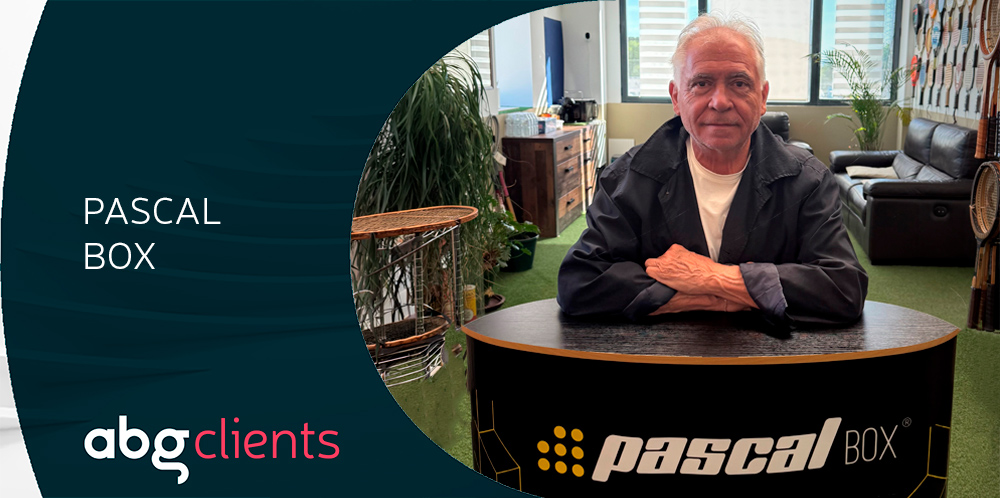
Against this backdrop, Pascal Box emerged as a Spanish company that has developed technological solutions to restore and maintain the pressure of padel balls, extending their useful life and improving the quality of play. The project is led by Fernando Luis Ramiro, Chief Executive Officer, who succeeded in turning a need identified in amateur play into an innovation with industrial and commercial potential in a rapidly expanding market.
In this interview, Fernando Luis Ramiro looks back on the origins of Pascal Box, its evolution towards agreements with leading players in the sector, and the decisive role played by intellectual property protection in consolidating and enhancing the value of the project.
Pascal Box: the importance of ball pressurisation
You started this project because you were a padel enthusiast, right?
Fernando Luis Ramiro: I’ve played racket sports all my life, practically all of them. Badly, all of them, but yes, all of them.
How did your inventive side come about?
I worked mainly in the chemical and pharmaceutical industry throughout my career. At one point, the company I was working for, which was based in Spain, moved to another country and I couldn’t find a job that appealed to me. During that period, I had more free time and devoted more of it to sport. I started playing padel and realised that the way we used balls was terrible: we had to throw away balls that were practically new because they lost pressure. When we played a match, the balls would hold up reasonably well that day, but by the next day they no longer played properly. I thought something had to be done about that, because it’s a real shame. Rubber is a highly polluting material; it takes a very long time to degrade, sometimes as much as 1,000 years.
When the ball loses pressure, what changes in the game?
In all sports that use balls, it is essential for them to retain pressure, because if a ball doesn’t bounce properly, the effort and movements involved change, and that leads to many injuries. In padel, the main issue is epicondylitis, or tennis elbow; the elbow suffers enormously because you have to make unnatural strokes and hit the ball much harder.
You identified a problem and set out to solve it
Exactly. The first thing I had to do was look for information on the characteristics of the ball. And even with everything that is available on the internet today, there still wasn’t enough information. I had to start figuring it out for myself.
At that stage, patent databases are very valuable. Did you carry out a prior art search?
That was precisely when I got in touch with you, specifically with Fernando Prieto from ABG’s engineering patents team. He told me, “I’ll take a look”, and interestingly enough, something did come up, I think from the 1950s. But it was more of a contraption. It would have cost a fortune to make, and the aim was to recover a product, a can of balls, that today costs around €8–9. You can’t make a major investment for that.
From a homemade prototype to global reach

So you began devising a solution. What were the early days like?
I ran into many problems and had many doubts, but through patience and perseverance I came to the conclusion that pressure could indeed be restored. I had a small laboratory at home and built my first prototype using items I bought from a hardware shop. We’re talking about around 2012. I burdened my friends with my ideas and concerns, we started testing it and saw that the ball really did recover. From there I moved on to a more professional prototype and, once I had it, I thought: “What do I do with this now?”
And what did you do?
I put myself in the hands of a friend who works in setting up companies and start-ups. He told me: “I’ve no idea; I know padel exists, and not much else”, although this was quite some time ago. He studied the case and I must admit I was a bit scared when we saw how much money was needed to launch the project on the market: our estimate was €400,000. For an individual, that is a lot of money, but I said to myself: “Let’s give it a try.” And that’s how Pascal Box was born.
And when you launched the product, what were the first market contacts like?
It was very tough because nobody paid any attention to us. I could write a whole book of anecdotes. People would say things like: “Where’s the little hole where you put the pressure in?” They associated it with footballs or basketballs, which have a valve. It was very difficult, essentially from 2014, when the first patent was granted, until 2020.
IP protection as a driver of success

For you, was it important to protect your intellectual property from the very beginning?
Every time something came up, I spoke to Fernando Prieto. Whenever I had anything, I asked him and followed his advice, and I don’t think we’ve ever got it wrong.
We also registered the industrial design when sales were negligible. But there was one thing that gave me great confidence: anyone who tried the ball pressuriser was delighted with the product. And I kept telling myself: “Since I know this works, it’s now just a matter of getting everything else right.”
And when and how did the breakthrough come?
In December 2019, at the Padel Master Final, we signed an agreement with the world’s number one company, Bullpadel. That’s when everything changed.
Shortly afterwards, COVID arrived, so there was a certain slowdown in 2020; but fortunately padel was one of the sports that could still be played because of social distancing, and we soon began to grow rapidly. It spread further and today we have a global presence.
In 2019, when you signed the agreement, how important was it for Bullpadel that your invention, designs and brand were protected? Do you think they valued that?
Yes, absolutely. And not just this company, with whom we continue to work and with whom we have an excellent relationship; we have received acquisition offers, and the very first thing we were always asked was whether we had patents or protected products. Always. I also believe that industrial design has helped us enormously.
From idea to invention; from invention to business

How many people do you currently have on your staff? I imagine you also generate indirect employment, right?
We are a small team because what we mainly do here is assembly and quality control. However, with the exception of a pressure gauge, which comes from Germany, all components are made in Spain. For example, the amateur line pressuriser, for three and four balls, is manufactured using special plastics such as polycarbonate and fibreglass in Alicante, which requires very large injection-moulding machines; that company works almost exclusively for us because we demand large volumes. We also have to bear in mind that Bullpadel are our partners, and they handle virtually all logistics, foreign trade and part of the commercial side. We take care of marketing, some administration, and innovation, development and research; around 14 people. Then we also have warehouse and quality control staff, another 20 people or more.
What products do you currently have on the market?
In the amateur line we have three devices: one for three balls, another for four, and the most recent one, which also works for three or four balls but is automatic: we have incorporated a small compressor with a battery. You just press a button and that’s it.
We also have the professional line, which has a larger lid and is made of stainless steel. We have one for 75 balls and another for 250; this is the professional line for padel and tennis coaches and clubs.
What advantage does the pressuriser offer clubs?
With our system, you greatly extend the life of balls used in lessons. In fact, clubs use practically the same set of balls all year round, with the added benefit that all balls bounce in the same way because they all have the same pressure. The equipment costs between €700 and €1,500, but it lasts a lifetime and pays for itself immediately. It is true that proportionally we sell far more outside Spain than within Spain. In Europe in particular, there is enormous growth because many padel clubs are private companies with a business-oriented mindset.
And have people tried to copy you?
Yes. That was around five years ago, in 2021 or 2022, when there was an explosion in the market. Once we became a benchmark, people started copying us with small variations. These are usually products with shortcomings. On some occasions, when we’ve seen certain advertising, we’ve contacted them and they have withdrawn it.
That’s in terms of pressurisers. Do you have any other products?
In padel, very few items are actually used: to play you need shoes, a racket and a ball. Not much else.
But we do have another protected invention, which is a ball dryer. It’s like an oven. It’s a very practical invention in areas with high humidity, as is the case in almost all of Europe and in northern Spain. In this case, a club in Bilbao contacted us because, in foggy and damp conditions, the balls become very heavy and, even if the ball recovers its pressure, it doesn’t dry because it is in a hermetically sealed container. The challenge here was not to damage the rubber, which is very sensitive to temperature. But we managed to develop a machine that dries balls in 15 minutes without damaging them.

A niche where innovation has taken root
Are you still trying to improve the product? Do you keep innovating?
Yes. In fact, the latest one was presented in September 2025. We waited for the design to be registered and then around 50 Pascal Box ambassadors started testing it. We launched it on the market in December 2025, and now, in April, it is gradually becoming established, although the price is double that of the other model. In any case, what reassures me most is that we have had no problems at all, and that is a guarantee.
Once it’s launched, I’m already thinking about the next one, but it won’t be released for at least two years, because developing a product and being sure that it works takes a long time.
Do you think people will start taking better care of balls in the future?
Generally speaking, it’s more convenient to buy new balls, spend €6 or €7, play and throw them away. It’s true that in Europe there is quite a lot of environmental awareness, but in other countries there isn’t as much; in the United States, for example, they buy balls and throw them away. We’re not used to taking care of balls. I suppose that when the price of balls rises, as it will because of hydrocarbons, we will start taking better care of them.