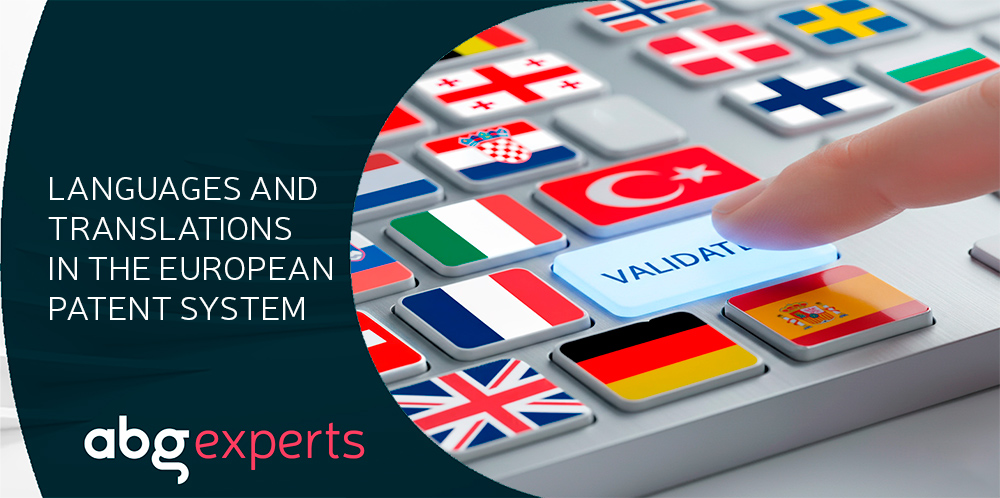
The language regime of the European patent system directly affects processing and validation costs and times. Knowing in which languages a European patent application can be filed, in which languages it is processed, and which translations must be filed during the proceedings and after grant is essential when it comes planning an effective international protection strategy for an invention.
In this article we review how the entire system works, but not before highlighting that patents are a complex concept where science, language and law intersect. Each application represents a technical invention with a legal purpose and, as such, the translation of the original text must be formulated with the utmost terminological precision as well as be absolutely faithful to the content. It’s not just a matter of transferring words from one language to another, but of translating innovative, sometimes entirely novel, concepts that delimit the legal scope of protection of an invention.
Filing languages of a European patent application
Patent applications can be filed with the European Patent Office (EPO) in:
- Any of the EPO’s three official languages:
English, French or German. - Any other language, such as Spanish or Chinese, provided that a translation into English, French or German is filed within two months (Art. 14(2) European Patent Convention, EPC).
Language of proceedings with the EPO: English, French or German
The official language of the application that has been filed (or which has been selected for filing the first translation) will also be the language of the application published 18 months after filing, the language of the rest of the written proceedings and the language of the necessary amendments made to the patent application.
Translation of the claims after grant
When the EPO intends to grant a patent (Rule 71(3) EPC), it invites the applicant to:
- pay the fees for grant and publishing, and
- file translations of the claims in the EPO’s two other official languages.
For example, in the case of a patent processed in English, the French and German translations of the claims (not the entire application) must be filed for their multilingual publication in the European patent specification.
Translation in validations country by country
Once the European patent has been granted, it must be validated in each of the designated countries where the invention is to be protected. This is where Article 65 EPC comes into play, allowing States to require a translation of the patent text into their national language within three months “unless the State concerned prescribes a longer period”.
Only Iceland (four months) and San Marino (six months) have extended the standard period, which is therefore three months for the vast majority of EPC signatory countries.

Later on we’ll see that the London Agreement eliminates or simplifies translation requirements in certain countries. Before getting there, however, it is worth mentioning that the European Patent Convention, in its Article 70(3), provides that, in the event of discrepancies between the official language in which the European patent was granted and the translation used for validation, the States may lay down that the translation will prevail if it confers a narrower scope of protection.
The purpose of this is to prevent translations from including self-serving amendments that extend the protection of the invention; however, it also demonstrates that absolutely flawless translations are critically important, as otherwise the proprietor risks having a reduced scope of protection for their development in that particular country due to translation errors. Moreover, Article 70, paragraph (4)(b), states that even if the translation is corrected during the life of the validation, any third party who entered the market without infringing the original erroneous translation, but who would infringe the corrected translation, may continue the same commercial activity without having to compensate the patent holder, even after the translation has been corrected.
In fact, all the aforementioned articles are applicable in Spain.
What is the London Agreement?
The London Agreement, in force since 2008, is a treaty that reduces requirements relating to national translation after the grant of a European patent.
It applies only in countries that have ratified or acceded to it, and makes it possible to:
- Completely remove the translation, if the official language of the country coincides with one of the EPO’s languages (English, French and German).
- Limit the translation to the text of the claims (not the full text), if the country does not have an official language in common with those of the EPO.
The fact that many countries have adopted this Agreement has led to significant translation and management cost savings, in addition to streamlining the process of validating European patents in the various signatory countries of the EPC.
Nevertheless, not all Contracting States of the European patent system have signed the London Agreement. The most common reason for refraining from doing so is that they consider that patents should be fully available in their official language to thus ensure legal certainty for their citizens (who are not required to understand the EPO’s official languages) as well as provide full access to technical information for researchers, companies and courts.
Languages and validations of European patents country by country
If the text of a patent is in English, the current situation would be as follows under the London Agreement or other similar agreements:
| Translation requirements | Countries |
| No translation of any kind is required | Belgium, France, Germany, Ireland, Luxembourg, Malta, Monaco, Switzerland-Liechtenstein, Tunisia and United Kingdom |
| Translation of the claims into the national language only | Albania, Bosnia & Herzegovina, Cambodia, Croatia, Denmark, Finland, Hungary, Iceland, Latvia, Lithuania, Macedonia, Montenegro, Morocco, the Netherlands, Norway, Slovenia and Sweden |
| Require a complete translation of the text of the patent into the national language | Austria, Bulgaria, Cyprus, Czech Republic, Estonia, Greece, Georgia, Italy, Moldova, Poland, Portugal, Romania, San Marino, Serbia, Slovakia, Spain and Turkey |

Validations in Spain: full translation of the granted patent
Spain is not a signatory to the London Agreement. Therefore, in order to validate a European patent in Spain, filing the complete translation of the text into Spanish, including the description, claims, drawings, etc., continues to be mandatory.
We reiterate here that reviewing and ensuring the quality of translations is not merely a formal or linguistic matter, but an act of legal certainty with economic and strategic implications.
That’s why, in ABG’s validation processes in Spain and Portugal, each translation is reviewed by professionals specialised in the corresponding technical subject matter, and the processing is based on a strict double-checking system that guarantees accuracy, compliance with deadlines and clarity for the client.
The unitary patent and translations
The entry into force of the unitary patent system has significantly transformed the issue of translations after the grant of a European patent. It is important to recall that this new system, which started on 1 June 2023, allows a granted European patent to take effect in all participating EU countries by filing a single application with the EPO and without the need for national validations.

Today, 18 countries participate in the unitary patent system and the Unified Patent Court (UPC). In these “UPC” countries, although it is still possible to validate the European patent country-by-country on a transitional basis, it is now possible to apply for unitary effect and for the patent to be valid in all of them through a single procedure. This can be done within one month from the publication of the European patent grant and it must be accompanied by a single translation.
The language of the translation accompanying the request for unitary effect depends on the language in which the patent was processed at the EPO:
- If the language of the proceedings with the EPO was German or French, an English translation must be provided.
- If the language of the proceedings with the EPO was English, the translation may be into any official language of an EU State, whether that country is a member of the unitary patent system or not.
Spain, Spanish and the unitary patent
Spain is not currently part of the unitary patent system; nor is it a signatory to the London Agreement. Therefore, for a European patent to be valid in the country with the fourth largest economy in Europe, a translation of the complete text of the patent application (not only the claims) must be filed and the classic validationpath must be followed.
As we have seen, the period for applying for validation in Spain is three months from the publication of the patent grant, while the deadline to apply for unitary effect is only one month.
However, when the language of the proceedings with the EPO is English, there is nothing to prevent the same translation into Spanish from being used for both procedures, in other words, applying first for unitary effect and then for validation in Spain. In fact, since the implementation of the unitary patent system, this language has become the one most frequently chosen to accompany the application for unitary effect, since, as mentioned, it takes advantage of an expense that is necessary when a European patent is to be protected in Spain.
For instance, to date, about one third of all applications for unitary effect are accompanied by a Spanish translation, a percentage that increases to over 40% among patents that have been processed in English and which are therefore the only ones that can choose to provide the translation in any official EU language.
Conclusion: translations are a strategic variable in international patent protection
In the patent system, languages and translations are not an incidental aspect, but a decisive factor in any international protection strategy. Language requirements directly influence deadlines, legal certainty and especially costs, which can represent a significant portion of the total budget depending on the countries in which protection is sought.
As we have seen, in Europe, after the London Agreement that took a step towards simplifying language requirements, the entry into force of the unitary patent has completely changed the panorama for European patents. Moreover, it has generated new opportunities for economic efficiency that coexist with the classic path of country-by-country validation, which continues to be necessary to obtain protection in key markets, as is the case of Spain.